
What Can Your Vehicle Tow? Trailer Weights by Type
The honest answer starts with a number printed on your own vehicle, not with a trailer. Find your tow rating and your payload, then compare them against a trailer's GVWR — the maximum it is allowed to weigh loaded — rather than its empty weight. Get those two comparisons right and everything else about towing gets easier.
The two numbers that decide it
Tow rating is the maximum trailer weight your vehicle is rated to pull. It varies enormously within a single model depending on engine, axle ratio, cab and bed configuration, and whether a factory tow package was fitted. Two identical-looking trucks can differ by thousands of pounds.
Payload is what your vehicle can carry — and it is the one people forget. Tongue weight, typically 10 to 15 percent of the loaded trailer, presses down on the hitch and counts against payload. So do passengers, fuel, tools and anything in the bed. It is entirely possible to be inside your tow rating and over your payload at the same time, and payload is usually what runs out first.
Both numbers are on a sticker in the driver's door jamb, and payload is specific to your individual vehicle as built. Use that sticker, not a magazine figure for the model.
Typical empty weights by trailer type
These are rough ranges for planning only. Every trailer carries its own rating plate and that plate wins over any general figure.
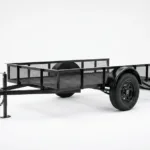
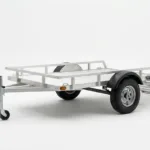
- Small utility trailers (4x8, 5x8) — a few hundred pounds empty, and light enough that many crossovers and SUVs can manage them within their ratings. This is the entry point for hauling.
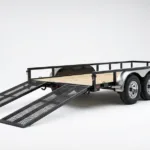
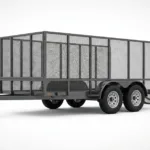
- Full-size utility and landscape trailers (6x12, 7x14, 7x16) — roughly 1,000 to 2,500 lb empty, with GVWRs commonly around 3,000 to 7,000 lb.
- ATV and powersport trailers — light, but check the payload against the machines. Two side-by-sides add up faster than expected.
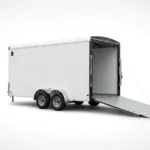
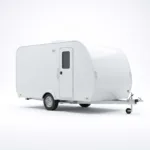
- Enclosed cargo trailers — heavier than open trailers of the same footprint because of the walls and roof, and much more affected by crosswind.
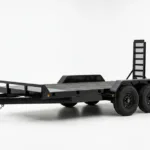
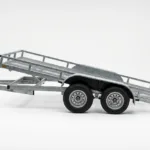
- Car haulers — commonly 1,800 to 3,000 lb empty, with GVWRs typically around 7,000 to 10,000 lb. The vehicle you are carrying usually weighs more than the trailer does.
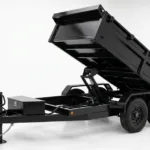
- Dump trailers — heavy empty because of the hoist and the steel bed, and they reach their GVWR quickly once loaded.
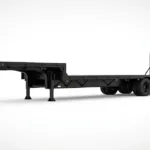
- Equipment trailers — built for machine weight, and normally beyond half-ton territory once loaded.
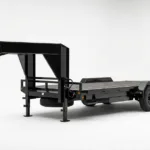
- Gooseneck trailers — require a hitch in the bed of a pickup and a truck rated for the load. See bumper pull vs gooseneck.
Doing the arithmetic honestly
Take the trailer's GVWR, not its empty weight, and check it against your tow rating. Then estimate tongue weight at 10 to 15 percent of the loaded trailer, add your passengers and cargo, and check that total against payload. If either comparison fails, the combination is wrong regardless of how it feels to drive.
A worked example. A car hauler with a 10,000 lb GVWR needs a vehicle rated to tow at least 10,000 lb if you intend to use its full capacity. Tongue weight at 12 percent of a 9,000 lb loaded trailer is about 1,080 lb — which on many half-ton pickups is most of the payload before anyone gets in. That is why car haulers so often end up behind three-quarter-ton trucks.
Our guides on what GVWR means on a trailer and how to tow a trailer safely go deeper on ratings and on loading.
What else changes the answer
- Brakes. Most states require trailer brakes above a weight threshold, and those thresholds are lower than people assume. See trailer brakes explained.
- Weight-distributing hitch. Above a certain tongue weight many manufacturers require one for the tow rating to apply at all. Check your owner's manual — this condition is frequently missed.
- Frontal area. A tall enclosed trailer or travel trailer creates far more drag than an open utility trailer of the same weight, and some manufacturers publish a frontal area limit alongside the tow rating.
- Altitude and heat. Ratings assume reasonable conditions. Long grades in summer heat are harder on a drivetrain than the flat numbers suggest.
- Hitch class. The receiver, ball mount and ball each have their own rating, and the lowest-rated component sets the limit for the whole system.
Frequently asked questions
What can tow a small 4x8 utility trailer?
Most vehicles with any factory tow rating, including many crossovers and small SUVs — these are among the lightest trailers made. Confirm against your own door-jamb sticker, and remember that a light trailer loaded with dense material is no longer a light trailer.
How much does a car hauler trailer weigh?
Commonly 1,800 to 3,000 lb empty depending on length and construction, with aluminium units lighter than steel. What matters is the GVWR plus the vehicle you intend to carry.
How much weight can a single axle trailer hold?
It depends on the axle rating and the trailer's GVWR, not on axle count alone. A common single axle is rated 3,500 lb, and the trailer's own empty weight comes out of that before any cargo. Tandem axles raise capacity and improve stability, and they also add empty weight.
Can I exceed the rating slightly if I drive carefully?
No. Ratings cover braking distance, frame stress, tyre load and heat, and they are set for the whole system rather than for a calm day. Exceeding them also affects insurance and liability if something goes wrong.
Browse by what you need to haul: utility, car haulers, equipment and enclosed cargo. Every trailer includes free delivery.